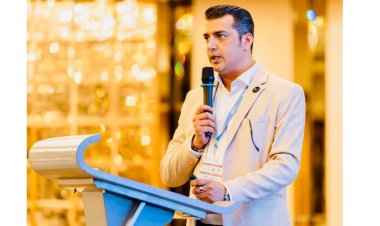
From AI Experiments to AI Infrastructure: How Atul Kumar Is Thinking About the Next Generation of Intelligent Systems
 digitalpressplug@gmail.com
Artificial intelligence is moving into a new phase. The early excitement was largely about what generative AI could produce, including conversations, images, software and automated content. As businesses begin incorporating AI into products, operations and decision making, the more important question is becoming whether these systems can be trusted to work in the real world. This is an area that has increasingly shaped the work of Atul Kumar, a product and innovation architect whose work spans enterprise AI, intelligent automation, AI powered manufacturing and emerging agentic systems. Rather than focusing only on increasingly capable models, Kumar's work looks at the wider environment required to make AI useful, dependable and responsible in practice.
This perspective is evident in Kumar's technical writing for platforms including HackerNoon and DZone. In The Hardest Part of AI Isn't the Model Anymore, he examines issues such as evaluation, memory, monitoring, cost and governance, arguing that an AI system cannot be considered reliable simply because its answers appear convincing. His work also explores the rise of AI agents and AI workers, where systems are beginning to move beyond answering questions and toward performing tasks. This development raises broader questions for organisations around permissions, accountability and human oversight. Kumar has approached these issues as part of the changing relationship between AI and the workplace.
His professional experience gives this perspective a practical foundation. Kumar has worked across enterprise AI and intelligent automation, including AI powered manufacturing initiatives involving areas such as defect detection, predictive maintenance, energy optimisation and operational visibility, alongside work involving predictive intelligence and computer vision. His interest is not simply in demonstrating what AI can do, but in how such systems can contribute to real business and operational environments. The same thinking appears in his work on AI assisted software development, where he has examined how coding agents are changing the role of engineers. His view is that the key consideration is not always the size of a task, but whether its outcome can be properly verified.
Kumar's public work has also gained visibility through the HackerNoon publishing ecosystem, including selection of his writing for its newsletter and trending content, with several essays subsequently adapted into HackerNoon's Machine Learning Tech Brief audio content. Across his work, a consistent theme emerges: the next stage of AI will require more than increasingly powerful models. Businesses will need to think about reliability, responsibility, oversight and how intelligent systems fit into the environments where people actually depend on them. The first wave of generative AI demonstrated what these systems could produce. The next wave will increasingly determine what organisations can responsibly trust them to do. For Kumar, that transition from AI experiments to AI infrastructure is where the more important story is now unfolding.